Current maritime transport spot rates more than double their 2019 levels.


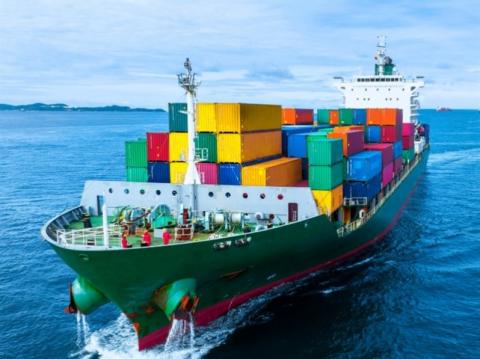
In the latest developments around the Red Sea, Yemen's Houthi rebels recently threatened to expand their attacks on maritime traffic in the Indian Ocean, with the aim of disrupting ships already diverting from the Red Sea towards the Cape of Good Hope. Although the majority of maritime container transport avoids the Suez Canal, the most determining factors are the decrease in demand and the stabilization of operations that have produced the continuation of the decrease in maritime rates on the main commercial routes.
According to Freightos Baltic Index (FBX) last week, weekly spot rate averages from Asia fell another 7% to North America (US$4,244/FEU to USWC and US$5,875/FEU to USEC) and between 10 % and 7% to northern Europe (US$3,871/FEU.) and the Mediterranean (US$4,155/FEU), respectively.
During this week rates have continued to fall, with rates to North America now around 25% lower than their peak in February, and rates to northern Europe and the Mediterranean now around 30% lower than their respective peaks at the end of February. January.
However, according to Judah Levine, head of research at Freightos, most analysts expect rates to remain well above normal levels as detours around the Cape of Good Hope continue, as shipping lines face higher costs. High altitudes and longer routes absorb more of their capacity. In fact, one piece of information about the cause is that almost 200,000 TEUs of new capacity were delivered in February alone, after the record of 300,000 TEUs the previous month; tonnage that was comfortably absorbed by the diversion routes around Africa.
“Still, current rates are about 2.5 times their 2019 levels, suggesting there may be further declines before they stabilize at a new floor,” he notes.
Two positive signs and one negative
Optimistic demand projections in North America could also help keep rates to North America above normal, as shipping lines will reportedly add capacity next month in anticipation of an improvement in volumes.
The easing of Panama Canal restrictions announced last week – which will increase daily transits to 27 – is also a good sign for shipping lines operating on transpacific routes to the USEC. Although it should be mentioned that the number of transits is still significantly lower than the 36 daily transits typically available, when the interoceanic waterway maintains a normal flow of water.
However, concerns about the looming October deadline for the USEC and USGC dockworkers union to reach an agreement with port terminal operators may mean moving some of the lawsuit forward to the first few months. of this year's peak season or move some volumes to the (USWC), although many are hopeful that labor disruptions can be avoided. This is the case of Peter Friedmann, executive director of the Agricultural Transportation Coalition, who projected that despite the strident language of union leaders, importers who use USEC ports should expect an agreement between employers and ports before the term of the current collective agreement.
Air freight
Although ocean flows out of India are improving, there is still additional pressure on the subcontinent's air cargo that began in late January, due in large part to disruptions caused by the conflict in the Red Sea.
Freightos Air Index rates from South Asia reached US$4.60/kg to North America last week, up 55% from December, and prices to Europe almost double their year-end level of US $3.55/kg.
According to Freightos, demand from China has also increased in the last two weeks, with growing e-commerce volumes being one of the factors. Rates reached US$5.94/kg for North America and US$3.93/kg for Northern Europe last week.
U.S. passenger airlines choosing not to fully restore weekly itineraries to China, due to delayed tourism demand, may also pose some capacity constraints for this route.
Add new comment